
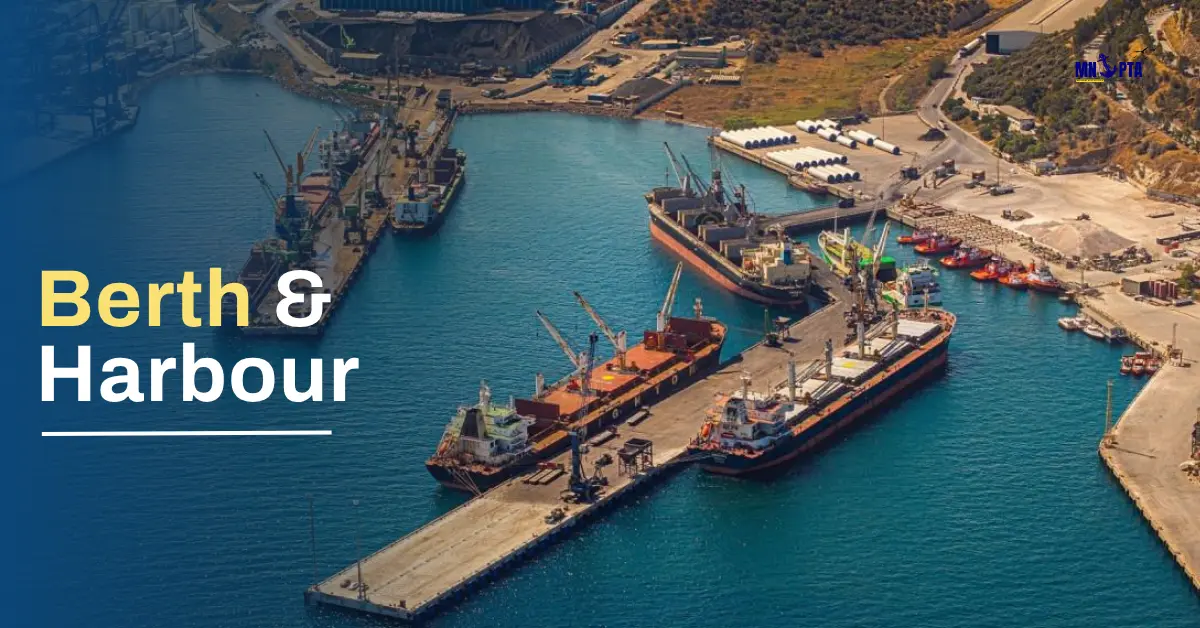
A harbour is a sheltered area of water where ships can enter, anchor, manoeuvre or remain protected from rough sea conditions, while a berth is a specific position where a ship is secured alongside a quay, wharf, jetty or terminal.
In very simple words:
Harbour = protected water area
Berth = designated place for a ship to stop alongside
A ship may enter a harbour, wait at anchorage and then move to its assigned berth for cargo handling or other operations.
That is the basic difference between a berth and a harbour.
What Is a Harbour?
A harbour is a protected body of water where ships and boats can find shelter from waves, wind and other sea conditions.
The protection may be provided naturally by bays, islands, headlands and the shape of the coastline, or artificially through structures such as breakwaters and harbour walls.
A harbour can provide enough sheltered water for ships to:
- enter and leave safely;
- anchor;
- wait for instructions;
- manoeuvre;
- seek shelter;
- approach port facilities;
- or move towards an assigned berth.
A harbour is therefore an area, not one particular parking position for a ship.
A harbour may contain several berths, anchorages, navigation channels and other marine facilities. It can also exist without extensive commercial port infrastructure.
What Is a Berth in Shipping?
A berth is a designated place where a vessel lies alongside a quay, wharf, pier, jetty or similar structure.
This is normally where the ship is made fast using mooring lines and can carry out activities such as loading cargo, discharging cargo, embarking passengers, bunkering or receiving supplies.
In professional container-shipping terminology, a berth is the space assigned to or occupied by a vessel while it lies alongside or is secured to a quay, wharf, jetty or similar structure.
Imagine arriving at a large airport.
The airport contains the entire operational area, while the gate is the particular position assigned to one aircraft.
A similar idea works at sea:
Harbour → larger protected area
Berth → specific position assigned to the vessel
It is only an analogy, but it makes the distinction easy to remember.
Berth vs Harbour: Key Differences
| Basis | Harbour | Berth |
|---|---|---|
| Meaning | A sheltered area of water | A designated position for a vessel |
| Size | Covers a comparatively large water area | Occupies a specific location |
| Main purpose | Protection and safe movement of vessels | Securing a vessel at a particular position |
| Vessel activity | Ships may enter, anchor, wait or manoeuvre | Ship normally remains secured alongside |
| Location | Along a coast, bay, estuary or protected waterway | Usually alongside a quay, wharf, jetty or terminal |
| Number | One harbour can serve many vessels | A port or terminal can have multiple berths |
| Cargo handling | Not necessarily | Commonly takes place at commercial berths |
| Mooring | Ship may be anchored or moving within the harbour | Ship is normally made fast at the berth |
| Example | Mumbai Harbour | A numbered container or tanker berth within a port |
The easiest distinction is therefore:
A harbour tells you the protected maritime area in which the ship is operating. A berth tells you the particular place where the ship is positioned.
How Does a Ship Move from a Harbour to a Berth?
Understanding the actual movement of a vessel makes the difference much clearer.
Suppose a container ship is approaching a busy coastal port.
1. The Ship Approaches the Harbour
The vessel arrives from the open sea and approaches the harbour entrance.
Depending on the location, navigation may be through a marked or dredged approach channel.
2. The Ship Enters Sheltered Water
After entering the harbour, the ship is comparatively protected from open-sea conditions.
But entering the harbour does not mean that the vessel has berthed.
It is still underway.
3. The Ship May Proceed to an Anchorage
If its berth is occupied, the vessel may be directed to an anchorage.
There it can drop anchor and wait until the port or terminal is ready to receive it.
4. A Berth Is Assigned
The port or terminal assigns the ship a suitable berth depending on factors such as:
- vessel length;
- vessel draft;
- cargo type;
- terminal requirements;
- berth availability;
- water depth;
- and operational schedule.
5. The Vessel Proceeds Towards the Berth
With pilotage and tug assistance where required, the vessel manoeuvres towards its assigned berth.
6. The Ship Is Secured
Mooring lines are passed ashore and secured to bollards.
Once properly positioned and made fast, the vessel is berthed.
Cargo, passenger or servicing operations can then begin.
The complete sequence may therefore look like:
Open Sea → Harbour Entrance → Navigation Channel → Anchorage → Berth
Not every ship follows every step, but this is a useful way for Merchant Navy students to visualise the relationship.
Is a Berth Always Inside a Harbour?
Not necessarily in the strict geographical sense.
This is where simplified definitions sometimes create confusion.
Many berths are located within protected harbours, but berths can also form part of ports situated on rivers, estuaries and other navigable waterways.
Therefore, it is better to remember a berth by its function and position rather than simply saying that every berth is inside a harbour.
A berth is the designated location where the vessel lies alongside or is secured for operations.
Can a Harbour Have More Than One Berth?
Yes.
A large commercial harbour may be associated with many berths, each designed for different vessels or operations.
For example, a port may have separate:
- container berths;
- oil tanker berths;
- bulk cargo berths;
- passenger berths;
- Ro-Ro berths;
- and general cargo berths.
Different berths may also have different permissible vessel lengths, water depths, equipment and terminal facilities.
This is why a vessel cannot simply enter a port and choose any empty-looking position.
It must be allocated a suitable berth.
Can a Harbour Exist Without a Berth?
Yes.
This distinction is particularly important.
A harbour is fundamentally about sheltered water.
A small natural harbour may provide anchorage and protection to vessels without having the developed infrastructure associated with a major commercial berth.
So:
A harbour does not automatically require a berth.
Similarly, having a berth is associated more closely with organised port or terminal operations than with the basic definition of a harbour.
Berth vs Anchorage: What Is the Difference?
A berth should also not be confused with an anchorage.
At an anchorage, the vessel normally remains in the water using its anchor to hold position.
At a berth, the vessel is normally secured to a fixed shore-side or marine structure using mooring lines.
| Anchorage | Berth |
|---|---|
| Ship normally uses its anchor | Ship normally uses mooring lines |
| Vessel remains away from the quay | Vessel is generally alongside a quay, jetty or terminal |
| Often used while waiting | Often used for operational activities |
| Cargo operations may be limited or specialised | Cargo handling commonly occurs here |
| Vessel has more movement around the anchor | Vessel is positioned alongside a structure |
A ship may therefore wait at anchorage before proceeding to its berth.
Berth vs Port: What Is the Difference?
A port is larger in scope than a berth.
A port is an organised maritime facility where vessels, cargo and sometimes passengers are handled.
It may contain:
- terminals;
- berths;
- warehouses;
- cargo-handling equipment;
- customs facilities;
- roads and rail connections;
- storage yards;
- and other infrastructure.
A berth, however, is just the designated position used by a vessel.
Think of the relationship as:
Port → Terminal → Berth
For example, a container terminal within a large port may contain several separate berths so that more than one vessel can be handled.
Harbour vs Port vs Berth
These three terms are often used together, but they should not be treated as synonyms.
| Term | Basic Meaning | Main Idea |
|---|---|---|
| Harbour | Sheltered water area | Protection |
| Port | Organised maritime facility | Operations |
| Berth | Specific vessel position | Placement |
A useful memory trick is:
Harbour protects the ship.
Port serves the ship.
Berth positions the ship.
This is simplified, but it captures the fundamental difference between the three terms.
Berth vs Quay: Are They the Same?
No.
A quay is a physical structure along the water’s edge where vessels may lie alongside and cargo or passengers can be transferred.
A berth is the designated vessel position associated with that structure.
A long quay may therefore contain several berths.
For example:
Quay = physical structure
Berth = allocated ship position along that structure
This is why port plans may show Berth 1, Berth 2 and Berth 3 along the same quay or terminal.
Berth vs Jetty
A jetty is a structure extending into or situated alongside navigable water.
A berth is the position where a ship is secured.
A jetty may therefore provide one or more berthing positions depending on its design.
Again, the important distinction is:
Jetty = structure
Berth = vessel position
What Does “Berthing a Ship” Mean?
Berthing is the process of manoeuvring a vessel into its assigned berth and securing it safely.
It is considerably more complicated than simply bringing a ship alongside a wall.
During berthing, mariners must consider factors such as:
- vessel speed;
- wind;
- current;
- tide;
- vessel draft;
- available water depth;
- turning space;
- tug assistance;
- berth dimensions;
- mooring arrangement;
- and the ship’s manoeuvring characteristics.
Cambridge defines the verb berth in the maritime context as bringing a ship or boat to a place where it is tied up and remains.
The opposite operation, when the vessel leaves the berth, is generally called unberthing.
Why Can a Ship Enter the Harbour but Still Wait for Hours?
Because harbour entry and berth availability are two separate things.
A vessel may have successfully reached the port area but still be unable to berth because:
- another vessel occupies its berth;
- terminal operations are delayed;
- cargo-handling equipment is unavailable;
- weather prevents safe berthing;
- tides or draft restrictions affect movement;
- pilots or tugs are unavailable;
- or the terminal schedule has changed.
Berth availability is one of the factors that can influence how quickly a vessel proceeds alongside after arrival.
This is why you may see several ships apparently “waiting outside” or anchored near a major port.
They may have arrived at the destination but are waiting for a suitable berth.
Why Is Berth Knowledge Important for Merchant Navy Students?
The word berth appears simple, but it connects with several important areas of ship operation.
A deck cadet or Merchant Navy aspirant will eventually encounter terms such as:
- berthing plan;
- berthing manoeuvre;
- berthing time;
- berthing window;
- berth allocation;
- berth occupancy;
- berth depth;
- berth number;
- berthing side;
- mooring arrangement.
Understanding what a berth actually represents makes these terms much easier to understand later.
It also helps distinguish a vessel’s different stages of arrival.
A ship can be:
- approaching the harbour;
- inside the harbour;
- at anchorage;
- proceeding towards the terminal;
- or alongside at berth.
These statements describe different situations.
Berth Meaning in Hindi
In maritime context, berth can be understood as:
जहाँ जहाज़ को खड़ा करके सुरक्षित रूप से बाँधा जाता है, वह निर्धारित स्थान।
A harbour can be understood as:
जहाज़ों के लिए सुरक्षित या संरक्षित जल क्षेत्र।
So the difference can be remembered in Hindi as:
Harbour = सुरक्षित जल क्षेत्र
Berth = जहाज़ खड़ा करने का निर्धारित स्थान
Simple Example of Harbour and Berth
Imagine a ship entering a large protected harbour.
The harbour contains:
- a navigation channel;
- an anchorage;
- several terminals;
- turning areas;
- and many berths.
The vessel enters the harbour first.
Its assigned berth is still occupied, so it waits at anchorage.
Once the previous vessel departs, the ship is instructed to proceed to Berth No. 5.
Tugs assist the vessel during the final manoeuvre.
The ship comes alongside, its mooring lines are secured, and cargo operations begin.
In this example:
The harbour is the larger protected water area.
The anchorage is the waiting area.
The berth is the vessel’s assigned position alongside.
That single example explains the relationship better than memorising three separate definitions.
Berth and Harbour: The Easiest Way to Remember
If you remember only one thing, remember this:
A harbour is where a ship finds protected water.
A berth is where the ship is given a specific place to lie alongside.
A vessel can be inside a harbour without being at a berth.
It may still be navigating through the harbour, waiting at anchorage or manoeuvring towards the terminal.
Only when it reaches its designated position and is secured alongside has it berthed.
For Merchant Navy students, understanding this distinction is far more useful than memorising similar-sounding definitions because it reflects what actually happens when a ship arrives at a port.
Frequently Asked Questions
What is the main difference between a berth and a harbour?
A harbour is a protected water area for vessels, whereas a berth is a particular position where a vessel is secured alongside a quay, wharf, jetty or terminal.
Is a berth a place where ships park?
“Ship parking place” is a useful beginner’s analogy, but technically a berth is the designated space assigned to or occupied by a vessel when it lies alongside a maritime structure.
Does every harbour have a berth?
No. A harbour can provide sheltered water or anchorage without having developed commercial berthing facilities.
Can one harbour have several berths?
Yes. Large commercial harbour and port areas can contain many berths serving different vessels and cargo operations.
What is the difference between berth and anchorage?
At an anchorage, a ship generally holds its position using an anchor. At a berth, it is normally secured alongside a quay, wharf, jetty or terminal using mooring lines.
What is the difference between berth and port?
A port is the wider operational facility containing terminals and maritime infrastructure. A berth is one specific position where a vessel can lie alongside.
What happens after a ship reaches its berth?
Once the vessel is safely positioned and moored, operations such as cargo loading or discharge, passenger movement, bunkering, stores delivery or other servicing may begin depending on the vessel and terminal.
What does “alongside” mean in shipping?
When a vessel is alongside, it is positioned next to a quay, wharf, jetty, another vessel or similar structure rather than remaining at anchor away from it.


