
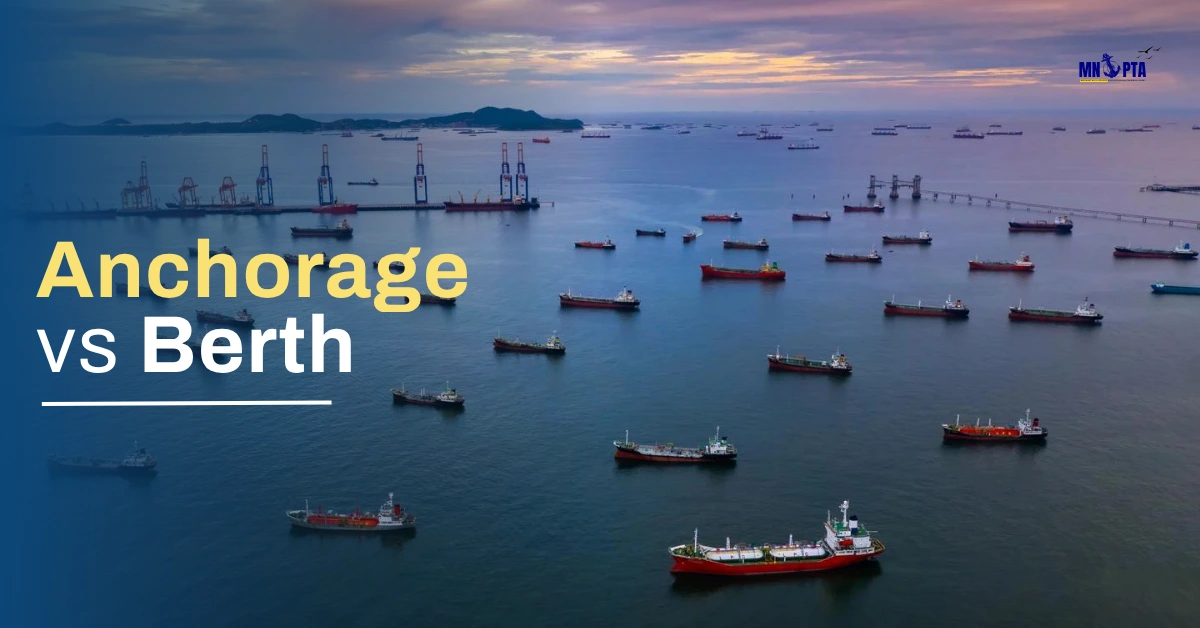
The main difference between an anchorage and a berth is how and where a ship is secured.
At an anchorage, a vessel normally remains in the water and holds its position using its anchor. At a berth, the vessel is assigned a specific position where it is secured, usually alongside a quay, jetty or terminal, for cargo handling, passenger operations or other port services.
In simple terms:
- Anchorage = the ship stays at anchor.
- Berth = the ship is secured at its assigned position.
A vessel arriving at a busy port may spend several hours or even longer at anchorage before a berth becomes available.
What Is an Anchorage?
An anchorage is an area of water where ships can safely drop anchor and remain for a period of time.
Anchorages may be located inside a harbour, outside a harbour or near the approaches to a port, depending on local geography and port arrangements.
A vessel may go to anchorage while waiting for:
- a berth to become available;
- port clearance or instructions;
- a suitable tide;
- pilotage;
- cargo instructions;
- bunkers or stores;
- inspections;
- or its scheduled port operation.
The important point is that the vessel is not alongside a berth. It remains afloat with its anchor and cable helping it maintain position.
A safe anchorage must also provide enough room for the ship to swing as wind, tide and current change its heading.
What Is a Berth?
A berth is a specific position assigned to a vessel where it can be secured for port operations.
Most commercial berths are located alongside a quay, wharf, jetty or terminal. Once the ship reaches the berth, mooring lines are used to secure it in position.
Depending on the type of terminal, the vessel may then:
- load or discharge cargo;
- embark or disembark passengers;
- receive bunkers;
- take provisions and stores;
- carry out crew changes;
- or receive other port services.
A container vessel, tanker and bulk carrier may all require very different types of berths because their cargo-handling systems and operational requirements are different.
So, while an anchorage is an area where a vessel can remain at anchor, a berth is a specific position allocated to the ship.
Anchorage vs Berth: Key Differences
| Basis | Anchorage | Berth |
|---|---|---|
| Meaning | Area where a vessel can anchor | Specific position assigned to a vessel |
| How the ship is secured | Primarily by its anchor | Usually by mooring lines |
| Position | In a designated water area | Usually alongside a quay, jetty or terminal |
| Main use | Waiting, holding or temporary stay | Port and terminal operations |
| Cargo handling | Possible in some operations, but not its primary purpose | Commonly carried out at the berth |
| Shore access | Usually limited | Direct access is normally available |
| Port equipment | Generally not directly accessible | Cranes, pipelines, ramps or other equipment may be available |
| Vessel movement | Ship can swing around its anchor | Vessel is held in a defined position |
| Allocation | Anchorage area or anchoring position | Specific berth number or location |
The most reliable way to remember the difference is:
At anchorage, the ship is held mainly by its anchor. At berth, the ship is secured at an assigned operating position.
What Happens When a Ship Arrives at Anchorage?
Consider a container ship arriving at a busy port.
The vessel has completed its sea passage, but its assigned berth is still occupied by another ship.
Instead of proceeding directly alongside, the vessel may be instructed to go to a designated anchorage.
Once the ship reaches its assigned anchoring position, the bridge team prepares for anchoring. The anchor is dropped, sufficient cable is paid out and the vessel’s position is continuously monitored.
The ship does not simply become stationary.
Wind and current can cause an anchored vessel to swing around its anchor. The bridge team therefore monitors the ship’s position, surrounding traffic, weather conditions and the possibility of dragging anchor.
When the berth becomes available, the vessel weighs anchor and proceeds towards the port or terminal.
What Happens When a Ship Reaches Its Berth?
Reaching the berth is a different operation.
As the vessel approaches its assigned position, its speed is progressively reduced. Depending on the ship, port and weather conditions, pilots and tugboats may assist with the manoeuvre.
The vessel is then brought into the required position and mooring lines are passed ashore.
Once those lines are properly secured and the vessel is safely positioned, the ship is all fast.
Terminal operations can then begin.
For example, a container ship may connect with shore cranes, while a tanker may connect its cargo manifold to the terminal’s loading arms or hoses.
This is why berthing refers to much more than simply arriving inside a port. The vessel has to reach and secure itself at its designated berth.
Why Do Ships Wait at Anchorage Instead of Going Directly to a Berth?
A ship can arrive at its destination without immediately receiving a berth.
This often happens because:
The Berth Is Occupied
Another vessel may still be loading or discharging cargo.
Until it departs, the arriving ship may have to wait at anchorage.
The Vessel Arrives Before Its Berthing Window
Port and terminal operations are scheduled carefully. A ship arriving earlier than planned may need to wait until its allocated time.
Tidal Restrictions Apply
Some ports can only accommodate deep-draught vessels during particular tidal conditions.
The ship may therefore remain at anchorage until there is enough water for safe entry.
Cargo or Terminal Operations Are Not Ready
Even if a berth physically appears available, the terminal may not yet be ready to handle the vessel.
Weather Conditions Prevent Safe Berthing
Strong winds, currents or poor visibility may make a berthing manoeuvre unsafe.
In such conditions, a vessel can be instructed to remain at anchorage until conditions improve.
Is Anchorage Always Outside the Port?
No.
This is a common misconception.
An anchorage can be inside or outside a harbour or port area. Its location depends on the layout of the port, available water depth, traffic routes, shelter and local regulations.
That is why defining anchorage simply as “the place where ships wait outside the port” is inaccurate.
A better definition is:
An anchorage is a designated or suitable area of water where a vessel can safely remain at anchor.
Is a Berth Always Alongside a Quay?
Usually, but not in every maritime operation.
Most people encounter berths as positions alongside quays, wharves, piers or jetties where ships can connect directly with shore facilities.
However, specialised facilities can use offshore or buoy-based arrangements as designated berthing or mooring positions.
For a basic understanding, however, remember:
Anchorage → vessel at anchor
Berth → vessel at its assigned operational position
That distinction remains useful even when the physical arrangement of the berth changes.
Can Cargo Be Handled at Anchorage?
Yes, in certain situations.
This is another reason why describing anchorage simply as a “waiting area” can be misleading.
Some vessels conduct operations while at anchor. Depending on local regulations and operational requirements, these may include:
- bunkering;
- taking stores;
- crew transfer;
- lightering;
- ship-to-ship operations;
- or limited cargo transfer.
However, routine commercial cargo handling is generally much easier at a properly equipped berth because the vessel has direct access to terminal infrastructure.
Therefore:
Berth = normally the primary operational position
does not mean:
Anchorage = no operations can happen there.
Anchorage vs Mooring vs Berth
These three terms are also frequently confused.
An anchorage is an area where a vessel can remain using its anchor.
A mooring refers to securing a vessel using lines, chains, buoys or other arrangements.
A berth is the particular position assigned to a vessel, commonly alongside port infrastructure.
A ship at berth is normally moored, but a ship can also be moored somewhere other than a conventional berth.
This distinction becomes important once you begin studying ship handling and port operations in greater detail.
Anchorage vs Harbour
An anchorage should not be confused with a harbour either.
A harbour is a larger protected water area where vessels can navigate, anchor or approach port facilities.
An anchorage is the particular area suitable or designated for vessels to remain at anchor.
A harbour may therefore contain one or more anchorages.
The relationship can be visualised as:
Harbour → Anchorage → Vessel at Anchor
and when the vessel is called alongside:
Anchorage → Berth → Vessel All Fast
Simple Example of Anchorage vs Berth
Suppose a bulk carrier arrives near a port at 6:00 AM.
Its berth will not become available until noon.
The vessel is instructed to proceed to Anchorage A.
It drops anchor and waits.
At 11:30 AM, the port informs the master that the berth is ready.
The vessel weighs anchor, takes the pilot onboard and proceeds towards the terminal.
Tugs assist during the final manoeuvre.
The ship reaches Berth No. 4, mooring lines are secured and the vessel becomes all fast.
In this example:
Anchorage A was where the vessel waited at anchor.
Berth No. 4 was the specific position where the vessel was secured for operations.
That is the practical difference between anchorage and berth.
Anchorage vs Berth: The One-Line Difference
The simplest accurate way to remember it is:
At anchorage, the ship is held by its anchor. At berth, the ship is secured at its assigned position for port operations.
A vessel may therefore arrive near a port, wait at anchorage, weigh anchor when called, proceed towards the terminal and finally berth.
Understanding that sequence makes the difference between anchorage and berth much easier than memorising two separate definitions.
Frequently Asked Questions
What is the difference between anchorage and berth?
An anchorage is an area where a vessel remains using its anchor, while a berth is a specific position where the vessel is secured for port or terminal operations.
Why does a ship wait at anchorage?
A vessel may wait at anchorage because its berth is occupied, it has arrived early, tidal restrictions apply, terminal operations are not ready or weather conditions prevent safe berthing.
Can a ship load cargo at anchorage?
Certain operations, including ship-to-ship transfers or lightering, can take place at anchorage. However, most regular cargo operations are carried out at equipped berths.
Is anchorage always outside a harbour?
No. An anchorage may be located inside or outside a harbour depending on the port layout and local conditions.
What does it mean when a ship is at berth?
It means the vessel has reached its assigned position and is secured there, normally using mooring lines.
What does “all fast” mean?
“All fast” means the vessel’s required mooring lines have been secured and the ship is safely positioned at the berth.
Does a ship always go to anchorage before berthing?
No. If the berth is available and the vessel has permission to proceed, it may go directly to its berth without waiting at anchorage.


