
The Merchant Navy is a respected and high-paying career that offers the opportunity to travel across the world while working on ships and managing global trade operations.
To ensure smooth and efficient communication onboard, seafarers use many short forms in their daily work.
Let’s now understand some popular Merchant Navy terms (Merchant Navy Full Forms) that are commonly used on ships and what they actually mean.
Deck Department Full Forms
The deck department is responsible for navigation, cargo handling, and overall ship operations.
- Deck Cadet – Trainee Navigating Officer
- OOW – Officer Of The Watch
- 3/O – Third Officer
- 2/O – Second Officer
- C/O – Chief Officer
- Master (Captain) – Overall in charge of the ship
- AB – Able Seaman
- OS – Ordinary Seaman
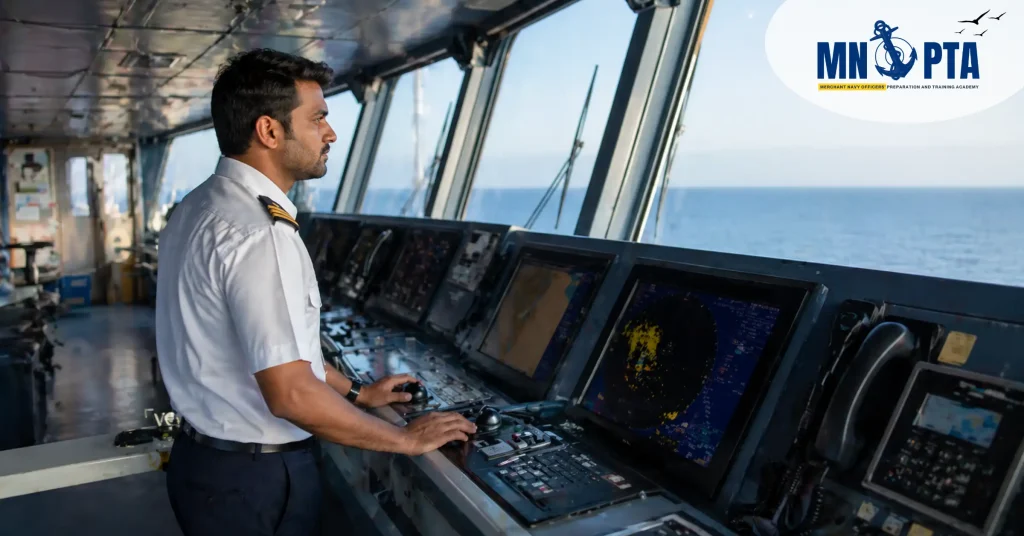
A Deck Cadet starts by learning basic operations, while officers handle navigation and planning. The Chief Officer manages cargo and deck crew, and the Captain has complete authority onboard
Engine Department Full Forms
The engine department ensures that the ship runs efficiently, safely, and continuously.
- CE – Chief Engineer
- CME – Chief Marine Engineer (less commonly used onboard)
- 2/E – Second Engineer
- 3/E – Third Engineer
- 4/E – Fourth Engineer
- ETO – Electro-Technical Officer
- GME – Graduate Marine Engineer
- Wiper – Entry-level engine crew
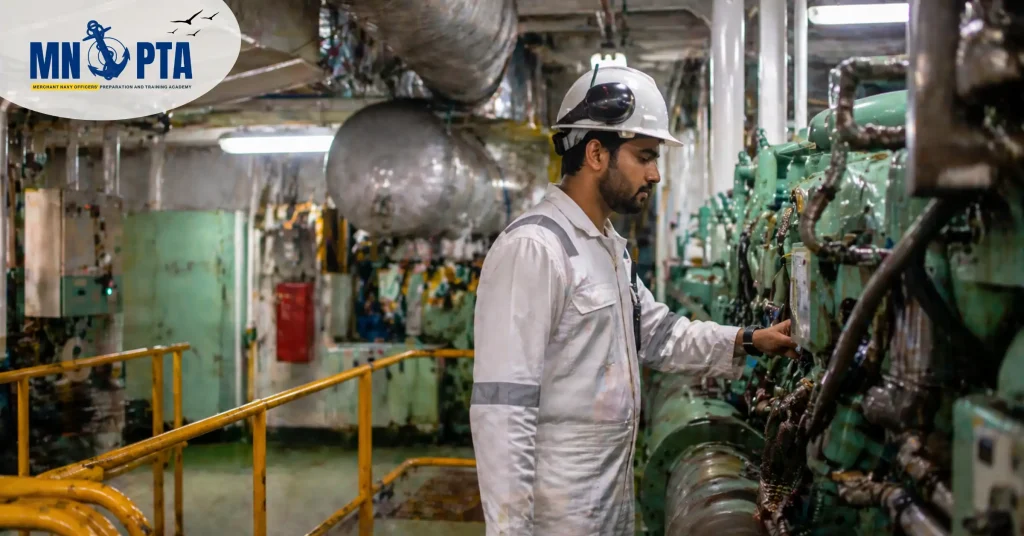
The Chief Engineer is the head of this department, responsible for all machinery. Engineers handle different systems, while the ETO manages electrical and electronic equipment.
Also Read: Merchant Navy Ranks 2026 – Deck and Engine Department
Navigation & Operational Terms
These are used daily on the bridge for planning and navigation.
- ETA – Estimated Time of Arrival
- ETD – Estimated Time of Departure
- GPS – Global Positioning System
- AIS – Automatic Identification System
- ECDIS – Electronic Chart Display and Information System
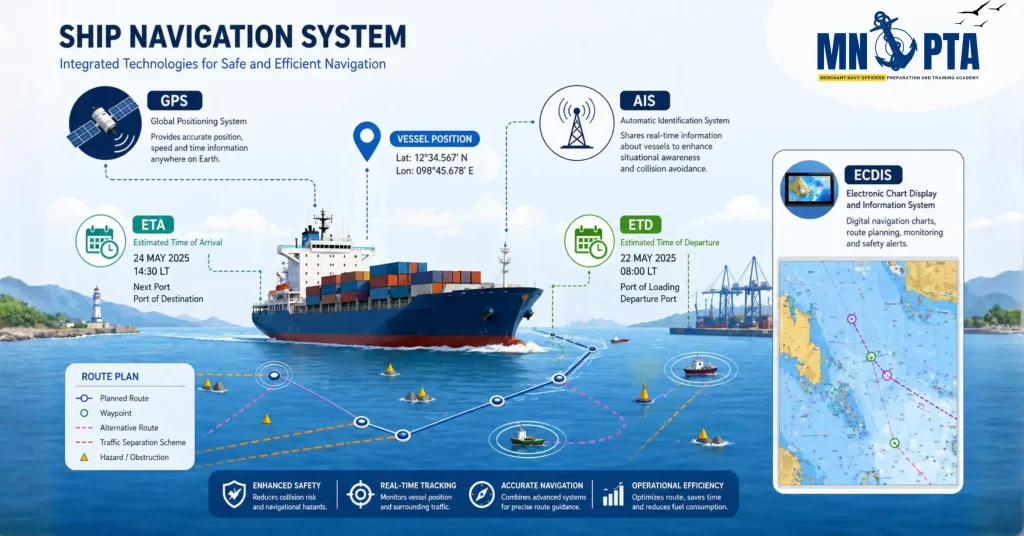
Understanding these terms helps you follow how ships move, track positions, and plan routes across oceans.
Safety & Emergency Full Forms
Safety is the backbone of the Merchant Navy. Every crew member must know these terms.
- SOLAS – Safety Of Life At Sea
- MOB – Man Overboard
- GMDSS – Global Maritime Distress And Safety System
- EPIRB – Emergency Position Indicating Radio Beacon
- SART – Search And Rescue Transponder
- HRU – Hydrostatic Release Unit
- LSA – Life Saving Appliances
- FFA – Fire Fighting Appliances
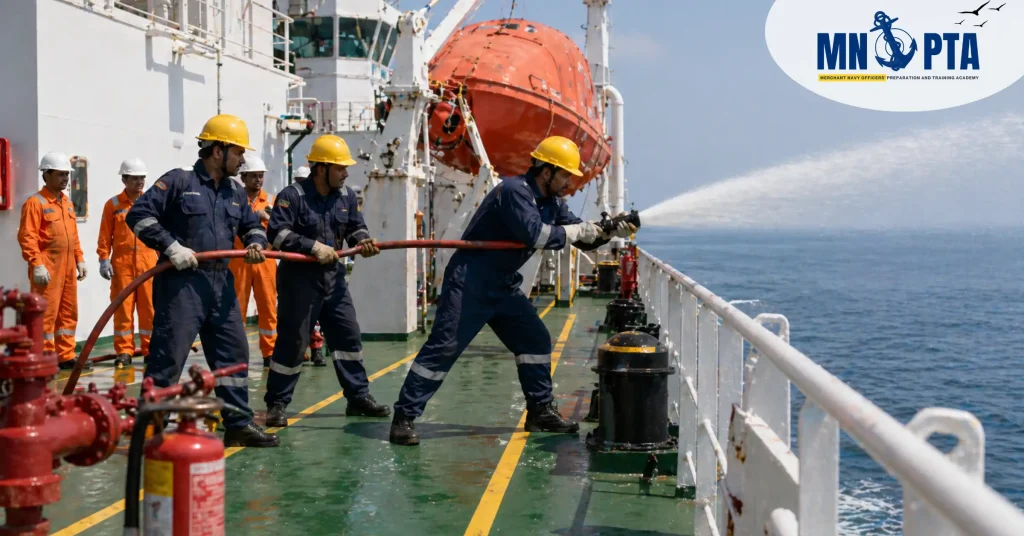
During emergencies, these abbreviations are used instantly, so there is no delay in response.
Cargo & Ship Measurement Terms
These terms are important for understanding ship capacity and cargo operations.
- DWT – Deadweight Tonnage
- GRT – Gross Register Tonnage
- TEU – Twenty-foot Equivalent Unit
- LOA – Length Overall
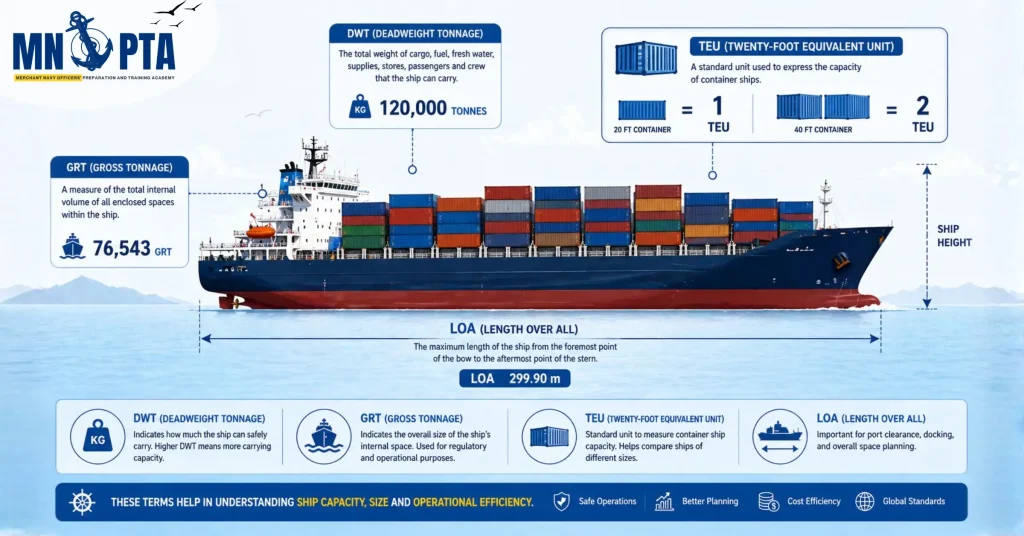
They are widely used in ports, shipping companies, and logistics planning.
Training & Examination Terms
Every aspirant will come across these before joining the Merchant Navy.
- IMU-CET – Indian Maritime University Common Entrance Test
- DNS – Diploma in Nautical Science
- BSc Nautical Science – Bachelor’s degree for deck officers
- MEO – Marine Engineer Officer (exam certification levels)
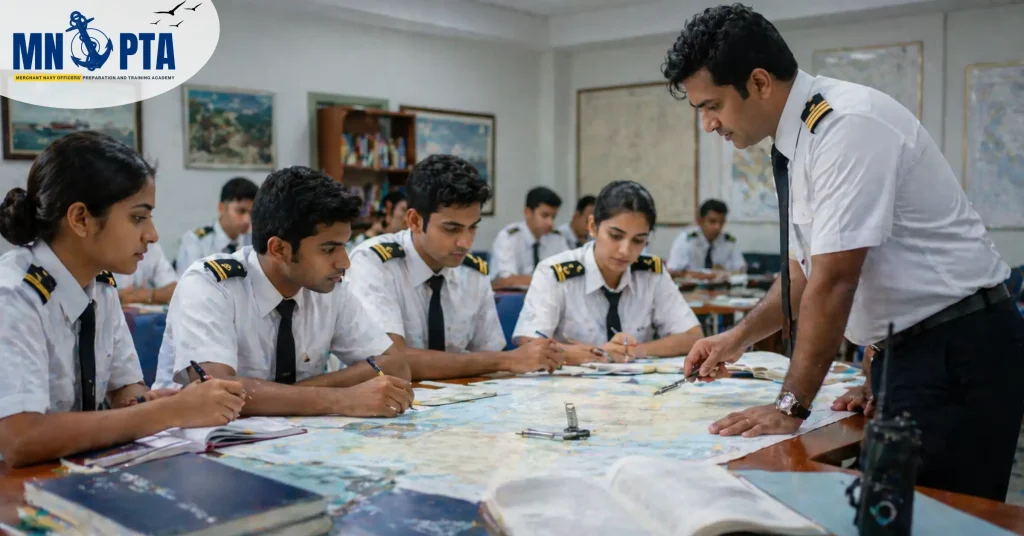
These are your entry points into the maritime career path.
Understanding a Real Ship Conversation
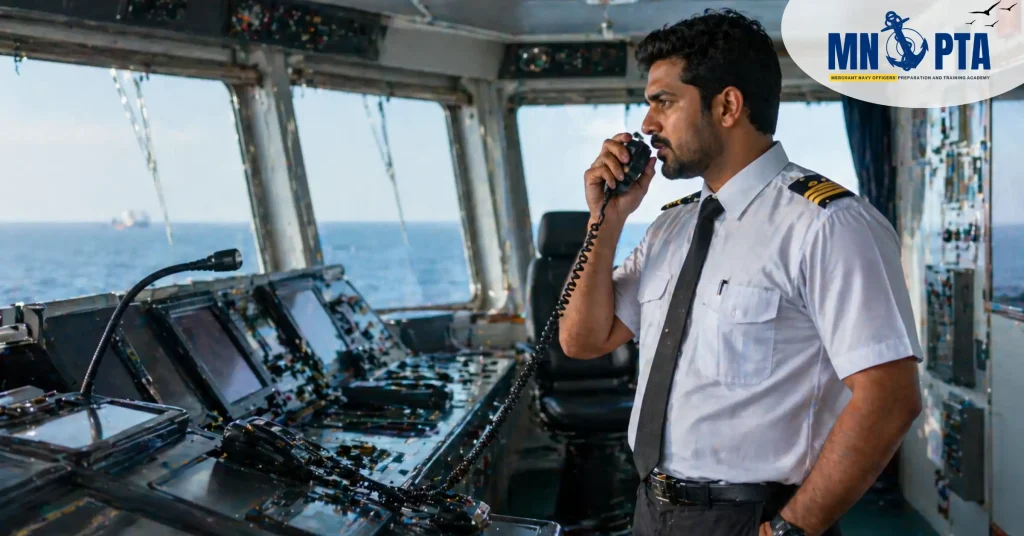
If you stand on a ship’s bridge during a watch, you will hear conversations like:
“OOW to engine room, reduce RPM, ETA revised.”
Now let’s understand what this actually means in simple words:
- OOW (Officer Of The Watch) → The officer currently in charge of the ship’s navigation
- Engine Room → The place where all ship machinery is controlled
- Reduce RPM (Revolutions Per Minute) → Slow down the engine speed
- ETA (Estimated Time of Arrival) revised → The arrival time has been changed
Full Meaning of the Sentence,
The navigation officer is telling the engine room:
“Please slow down the ship because our arrival time has been updated.”
Why these full forms matter in the Merchant Navy?
On a ship, there is no space for confusion.
Every instruction must be clear and understood immediately.
That is why short forms like OOW, EPIRB, and ETA are used instead of long sentences.
They help save time, avoid mistakes, and ensure that every crew member understands the situation quickly.
This becomes even more important during emergencies, where quick and correct communication can make a big difference.
Start Your Merchant Navy Journey
If you are serious about joining the Merchant Navy and want proper guidance, training, and clarity from experienced professionals, you can consider joining MNOPTA (Merchant Navy Officers’ Preparation and Training Academy) for your preparation.
Your journey at sea begins with understanding the basics, and these full forms are the first step.


