
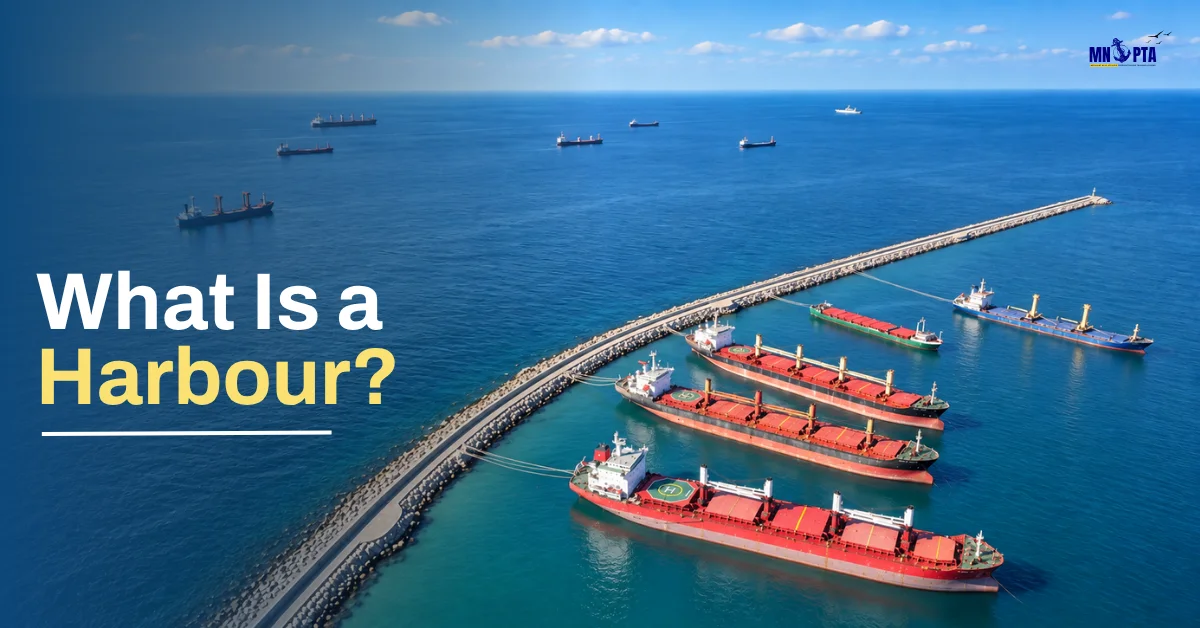
A harbour is a sheltered area of water where ships and boats can anchor, moor or wait safely, protected from strong waves, wind and rough sea conditions. This protection may come from natural landforms, man-made structures such as breakwaters, or a combination of both.
That is the simplest answer to what is a harbour.
But from a maritime point of view, a harbour is more than a quiet patch of water. Its entrance, water depth, navigation channel, anchorage and protective structures all influence how safely a vessel can enter, manoeuvre and remain there.
Harbour Meaning in Simple Words
Think of a ship sailing in the open sea.
In open water, the vessel is exposed to waves, swell, currents and changing weather. Near the coast, it needs an area where those forces are reduced enough for the ship to anchor, manoeuvre or berth safely.
That protected water area is a harbour.
The emphasis is important: the basic purpose of a harbour is shelter and safety for vessels.
A harbour may contain docks, jetties, terminals and cargo facilities, but these facilities are not what make it a harbour.
Why Do Ships Need a Harbour?
A ship cannot simply stop anywhere near a coastline.
Large vessels need sufficient depth below the keel, enough room to turn, safe approaches and protection from conditions that could make anchoring or berthing difficult.
A suitable harbour can provide relatively calm water where vessels can:
- anchor or moor safely;
- wait before proceeding to a berth;
- embark or disembark people where facilities exist;
- take shelter from rough sea conditions;
- carry out cargo or passenger operations when the harbour forms part of a port;
- receive supplies or services;
- and, in suitable facilities, undergo maintenance or repair.
Not every harbour performs every one of these functions. A small fishing harbour and a harbour serving large commercial vessels can look completely different while sharing the same basic purpose: providing protected water for vessels.
How Does a Harbour Protect Ships?
Protection can come from geography, engineering or both.
Imagine a bay surrounded by land on several sides. The surrounding coastline blocks much of the energy coming from the open sea. Waves entering the sheltered area become less severe, creating comparatively calmer water inside.
That is the principle behind a natural harbour.
Where the coastline does not provide enough protection, engineers can create it. Structures such as breakwaters and sea walls are positioned to reduce incoming wave energy while leaving an entrance through which ships can navigate.
The result is an artificial or partly artificial sheltered basin.
Protection alone, however, is not enough. A harbour intended for larger vessels also needs adequate navigable depth and sufficient room for safe movement. Where sediment gradually reduces water depth, dredging may be required to maintain the navigation channel or harbour basin.
Types of Harbour
Harbours can be classified in different ways. For a basic maritime understanding, the easiest classification is according to how the sheltered water area is formed.
Natural Harbour
A natural harbour receives most of its protection from the natural shape of the coast.
Bays, islands, headlands, estuaries or similar geographical features can shield the water from the direct effect of the open sea.
Because nature already provides much of the protection, fewer major protective structures may be needed compared with a completely artificial harbour.
Mumbai Harbour is an excellent Indian example. Mumbai Port Authority describes it as a natural deep-water harbour covering roughly 400 square kilometres and protected by the surrounding mainland and Mumbai island.
Artificial Harbour
An artificial harbour is created where sufficient natural shelter does not exist.
Engineers construct structures such as breakwaters, harbour walls and other protective works to form a safer water area for vessels.
One of India’s best-known examples is Chennai Harbour. Government maritime records describe Chennai Port as an all-weather artificial harbour.
Artificial harbours can provide excellent protection, but their channels and basins may require continuous inspection, dredging and maintenance depending on local waves, currents and sediment movement.
Semi-Natural Harbour
A semi-natural harbour uses both natural protection and man-made works.
Part of the shelter may already be provided by the shape of the coastline, headlands or surrounding land, while breakwaters or other structures improve protection at exposed sections or near the harbour entrance.
This three-part classification of natural, semi-natural and artificial harbours is common in Indian harbour-engineering education. In actual modern ports, the boundary is not always as neat because a naturally sheltered harbour can also contain major engineered channels, breakwaters, docks and terminals.
That distinction is useful: natural harbour does not mean untouched harbour. A naturally protected location can still be extensively developed.
Harbours Can Also Be Classified by Their Use
Another way to understand harbours is by what they are designed to support.
A commercial harbour supports merchant vessels and may be associated with cargo terminals, passenger facilities and other port operations.
A fishing harbour is developed mainly for fishing vessels and commonly supports landing, handling and related fishing activities.
A naval or military harbour provides protected waters and facilities for naval vessels.
A harbour of refuge is primarily intended to give vessels a protected place during difficult or dangerous sea conditions.
A marina or recreational harbour is designed mainly for yachts and smaller leisure craft.
These are functional descriptions rather than rigid boundaries. One large harbour may support several activities at the same time.
Main Parts of a Harbour
Once you understand the components, a harbour becomes much easier to visualise.
Harbour Entrance
The harbour entrance connects the sheltered water with the sea or other navigable water.
It has to provide safe access for vessels while still allowing the harbour to remain sufficiently protected from waves.
Approach or Navigation Channel
Large vessels cannot navigate through shallow water simply because a harbour exists nearby.
A defined channel provides the depth and width needed for vessels to approach or leave safely. Channels may be naturally deep, dredged or a combination of both.
Breakwater
A breakwater is a protective structure built to reduce the effect of waves inside the harbour.
It acts as a barrier between rougher open water and the sheltered harbour basin.
Breakwaters are especially important in artificial and partly protected harbours.
Anchorage
An anchorage is an area where vessels can anchor safely.
A vessel might use an anchorage while waiting for a berth, completing formalities, receiving instructions or simply remaining safely clear of other harbour operations.
Turning Basin
Ships cannot turn like road vehicles.
Large vessels need sufficient water space to manoeuvre. A turning basin provides an area where a ship can alter its heading before moving towards a berth or back towards the harbour entrance.
Berth
A berth is the designated position where a ship is secured for operations.
Cargo handling, passenger movement, bunkering, stores and other services may take place while the vessel is alongside, depending on the facility.
Quay, Wharf or Jetty
These are structures associated with berthing and vessel access.
The exact design and terminology differ, but they provide a physical interface between the ship and shore.
Navigation Aids
Buoys, lights, beacons and other aids help mariners identify channels, hazards and safe routes.
Modern vessel movement around busy harbour areas may also be supported by pilotage, traffic-management systems and detailed port procedures.
A particular harbour does not necessarily contain every component listed above. Its layout depends on vessel size, geography, traffic, purpose and local sea conditions.
Harbour vs Port: Are They the Same?
No. The words are related, but they describe different ideas.
| Harbour | Port |
|---|---|
| Primarily a protected water area | Primarily an organised place for vessel operations |
| Main idea is shelter and safe water | Main idea is cargo, passenger and maritime operations |
| Can be natural or artificially protected | Requires developed operational infrastructure |
| May exist without major cargo facilities | Usually includes terminals, berths and shore-side facilities |
| Focuses on the physical maritime environment | Includes both water-side and land-side operations |
A harbour may exist without being a major commercial port.
A port, on the other hand, is organised around vessel operations and normally includes infrastructure required for handling ships, cargo or passengers.
This distinction is also reflected in official marine terminology, where a harbour is defined around shelter and safe mooring while a port is described as a commercial facility containing land- and water-based infrastructure for vessel operations.
For a detailed explanation, read: Port vs Harbour: What Is the Difference?
Harbour vs Harbor: Which Spelling Is Correct?
Both words mean the same thing.
Harbour is the normal British English spelling.
Harbor is the normal American English spelling.
Indian maritime and educational writing generally follows British English, so harbour is normally the appropriate spelling in India.
The spelling changes. The maritime meaning does not.
Examples of Harbours in India
India has harbours shaped by very different coastal conditions.
Mumbai Harbour is a clear example of a natural deep-water harbour. The surrounding geography provides substantial natural protection to shipping.
Chennai Harbour, on the east coast, is an artificial harbour where engineering works provide the protection required for port operations.
Visakhapatnam shows why real-world classification can be more complicated than textbook diagrams. Government port statistics have described its inner harbour as natural and its outer harbour as artificial. A modern harbour system can therefore combine natural geography with substantial engineered development.
Why Is Harbour Knowledge Important for Merchant Navy Students?
For someone entering the Merchant Navy, “harbour” is not merely a geography definition.
A ship’s arrival at a harbour connects several practical maritime concepts: navigation channels, pilot boarding, anchorage, under-keel clearance, berthing, tides, currents, traffic movement and port regulations.
A cadet may first encounter the word in a simple question such as:
What is a harbour?
But the next questions can quickly become:
How is a harbour different from a port?
What does a breakwater do?
What is an anchorage?
Why is dredging required?
What is a turning basin?
What is the difference between a berth and a harbour?
Understanding the basic concept properly makes all of these subjects easier.
What Is Harbour Meaning in Hindi?
There is no need to complicate the translation.
In maritime context, a harbour can be understood as:
जहाज़ों और नौकाओं के लिए सुरक्षित या संरक्षित जल क्षेत्र।
The word बंदरगाह is also commonly used, although in everyday Hindi it may be used for both harbour and port. Technically, the two English terms do not always mean exactly the same thing.
The Simplest Way to Remember Harbour
Do not begin by memorising a long engineering definition.
Remember the purpose first:
A harbour gives a ship protected water.
Natural geography may create that protection. Engineers may create it with breakwaters. In many places, both work together.
Once that idea is clear, terms such as harbour entrance, anchorage, navigation channel, turning basin, berth and port become much easier to understand.
For anyone preparing for the Merchant Navy, that understanding is more useful than simply memorising one textbook sentence.
Frequently Asked Questions About Harbours
What is a harbour in one sentence?
A harbour is a sheltered area of water where ships and boats can remain safely protected from rough sea conditions.
What are the three main types of harbour?
In the commonly used engineering classification, the three types are natural harbour, semi-natural harbour and artificial harbour.
What is the main purpose of a harbour?
Its fundamental purpose is to provide safe and sheltered water for vessels.
Is a harbour the same as a port?
No. A harbour primarily provides protected water, while a port provides infrastructure and services for activities such as cargo handling, passenger movement and vessel operations.
Can a harbour exist without a port?
Yes. A sheltered water area can be a harbour even if it does not contain extensive commercial port facilities.
What is a natural harbour?
A natural harbour is an area where geographical features such as bays, islands or headlands naturally provide protection from the open sea.
What is an artificial harbour?
An artificial harbour is created or protected mainly through engineering works such as breakwaters and harbour walls.
What is a breakwater in a harbour?
A breakwater is a structure designed to reduce incoming wave energy and create calmer water inside the harbour.
Is Mumbai a natural harbour?
Yes. Mumbai Port Authority describes Mumbai as having a natural deep-water harbour protected by the surrounding mainland and island geography.
Is Chennai a natural or artificial harbour?
Chennai is an artificial harbour.


